The Future of Soil: SOB4ES Organises Mini Public for Young People in the Netherlands
On March 23rd, 2026, eleven young citizens and students joined SOB4ES for a mini public titled “Future Soils: Soil Health and Soil Health Monitoring in the Netherlands”, which was jointly organised by partners NIOO-KNAW and UGent.
Surrounded by the library and gardens of the historic Trippenhuis in Amsterdam, the participants, aged between 18 and 25, engaged in an open community dialogue, listening to soil experts and discussing what soil health and monitoring means for the Netherlands.
Mini publics are deliberative citizens’ engagement events, which provide a structured framework where citizens can interact with experts, learn about issues they are affected by and give their views and feedback. The outcomes of these mini publics are presented to policymakers, civil society and the public, thus directly influencing policies and their uptake.
“At the end of this thought-provoking day, people hopefully left with a bit more knowledge and an optimistic message,” says SOB4ES researcher Giles Ross. “Let’s build this community and promote young people to get involved and promote healthy soils in the Netherlands and the rest of Europe!”
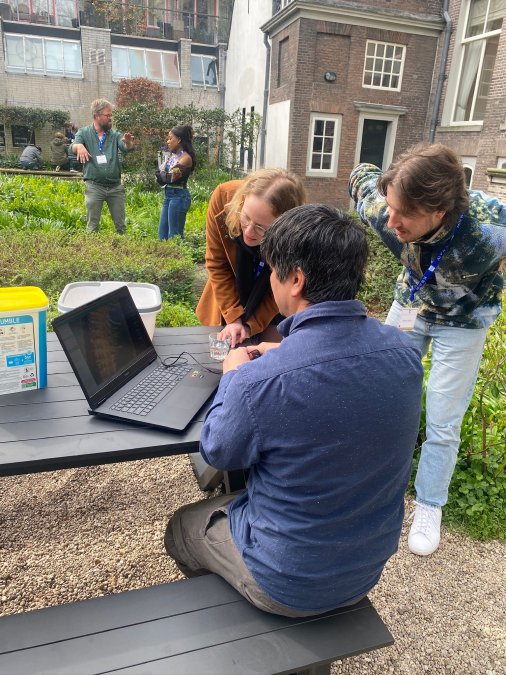
After first learning about soil biodiversity and soil health benchmarking, the participants were guided in a second part to get up close with some soil fauna themselves. In collaboration with Bodemdierendagen they gathered in small groups and carefully dug up the soil in the Trippenhuis garden and searched for life, examining the soil biodiversity under a mini-digital microscope attached to a laptop.
“Using the microscope to look at organisms in the garden was very interesting!” said one participant while another adds: “Finding the microfauna outside after learning about them was very fun and made the knowledge more tangible”.
In the afternoon, the participants had the chance to share their opinions in break-out groups, where they formulated policy recommendations for monitoring soil biodiversity at the local and national level. These discussions were particularly relevant, following the recent adoption of the EU Soil monitoring directive.
“It helped cantering the attention on soil at first before scaling up the issues to the societal and policy-making level,” summarised one participant. In a subsequent questionnaire, many participants ranked soil health as more important than before the event, highlighting the transformative effect that mini publics can have on connecting people to soil diversity. Most participants also emphasised the importance of discussions between people of different backgrounds. This also points to the community building potential of deliberative citizen engagement events.
The results of the discussions will be further evaluated and used to inform future policies. Watch the full video here.